
Citation Opportunities
The Citation Opportunities page shows you where competitors are getting cited in AI-generated answers — but your brand isn't. Think of these as gaps in your AI visibility that you can close through outreach, content improvements, or PR efforts.
This is one of the most actionable pages in Writesonic's GEO tool. Instead of guessing where to focus, you get a clear list of high-value sources that already influence AI answers — and specific ways to get your brand included.
Filters and Controls
At the top of the page, you'll find a set of filters to narrow down your view:
- Date range selector — Compare citation opportunities across two time periods to spot trends and new gaps.
- Markets — Filter by target region if you're tracking multiple markets.
- Topics — Focus on specific topic categories relevant to your business.
- Platform — Narrow results to a specific AI platform (e.g., ChatGPT, Perplexity, Google AI Overviews, Claude).
- Tags — Use tags you've configured in your project to slice the data further.
- Prompt type — Filter by the type of prompts driving the citation opportunities.
These filters help you prioritize opportunities that matter most to your strategy — whether that's a specific region, platform, or topic area.
Citation Gaps
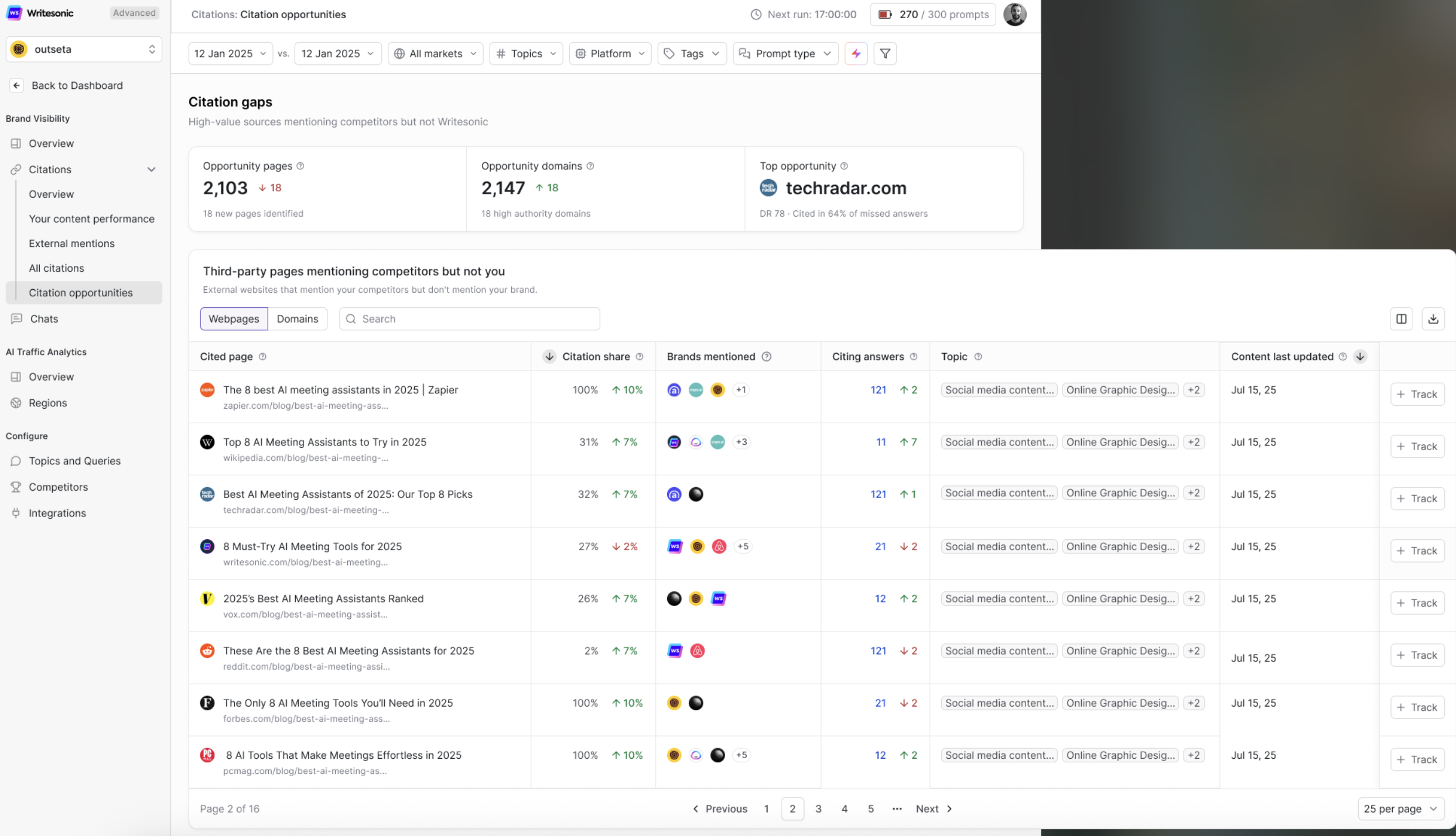
This is the summary section at the top of the page, giving you a quick snapshot of your total opportunity landscape.
- Opportunity pages — The total number of third-party web pages that cite your competitors but don't mention your brand. A change indicator shows how many new pages have been identified since the last period.
- Opportunity domains — The number of unique domains (websites) where these opportunity pages exist. This also highlights how many are high-authority domains.
- Top opportunity — The single domain that appears most frequently in missed citation opportunities. It shows the domain's DR (Domain Rating) and the percentage of missed AI responses that cite this domain.
Why it matters: These three metrics give you an at-a-glance understanding of how large the gap is between your brand's current citation presence and where competitors are winning. A high number of opportunity pages means there are many places where your brand could be appearing but isn't.
Third-Party Pages Mentioning Competitors but Not You
This is the main data table on the page — a detailed breakdown of external websites that reference your competitors but don't include your brand. You can toggle between two views: Webpages and Domains.
Webpages View
The Webpages tab shows individual pages where competitors are being cited. Each row includes:
- Cited page — The specific URL and page title of the third-party content. Clicking it opens the page for review.
- Citation share — The percentage of AI answers citing this particular page, with a trend indicator showing increase or decrease over time.
- Brands mentioned — Icons representing which competitor brands are mentioned on this page. A "+N" badge indicates additional brands beyond those displayed.
- Citing answers — The number of AI-generated answers that cite this page, along with a trend showing change over the selected period.
- Topic — The topic category this page falls under, based on your configured topics.
- Content last updated — When the page content was last refreshed, helping you assess how current the opportunity is.
- + Track — Click this to start tracking a specific page for ongoing monitoring.
Domains View
The Domains tab aggregates the data at the domain level, making it easier to identify high-priority websites for outreach. Each row includes:
- Cited domain — The root domain (e.g., zapier.com, techradar.com) with a clickable link. Clicking into a domain reveals all the individual pages underneath.
- Citation share — The domain's overall share of citations across AI answers, with trend data.
- Brands mentioned — Which competitor brands are referenced across pages on this domain.
- Citing answers — Total number of AI answers citing pages from this domain.
- Pages cited — The number of individual pages on this domain that are cited in AI answers, along with trend data.
- Topic — The topic categories covered by this domain's cited pages.
Why it matters: The Webpages view is best for execution — it gives you specific pages to target for outreach. The Domains view is best for strategy — it helps you identify which websites to prioritize building relationships with.
Both views include a search bar to find specific pages or domains, and pagination controls at the bottom to navigate through results.
Prompts Citing Competitors but Not You
Below the pages/domains table, you'll find a second critical section that flips the perspective. Instead of showing where competitors are cited, this section shows which prompts trigger AI answers that cite competitors but not your brand.
You can toggle between Prompts and Topics views.
Prompts View
Each row represents a specific prompt (a real question users ask AI platforms) where competitors are getting cited but you aren't. The columns include:
- Prompt — The actual question or query being tracked. These are the natural-language questions your potential customers are asking AI engines.
- Competitors cited — Icons showing which competitor brands are cited in the AI response for this prompt, with a "+N" indicator for additional brands.
- Citing answers — The number of AI-generated answers for this prompt that cite competitor content, along with a trend indicator.
- ChatGPT volume — The estimated search volume for this prompt on ChatGPT, giving you a sense of how many people are asking this question.
- Platform — Which AI platforms are generating answers for this prompt (shown as platform icons).
- Market — The geographic market and language this prompt is tracked for.
- Intent — The search intent behind the prompt, labeled as N (Navigational), I (Informational), C (Commercial), or T (Transactional). This helps you understand what the user is trying to accomplish.
- Topic — The topic category this prompt falls under.
Topics View
This view aggregates the prompt data into broader content themes, making it easier to spot patterns. Each row includes:
- Topic — The broader content category where competitors are consistently cited but you're not.
- Prompts to target — The number of individual prompts within this topic that represent citation opportunities, with trend data.
- Citing answers — The total number of AI answers across all prompts in this topic that cite competitors.
- Competitors cited — Which competitor brands are cited across this topic area.
Why it matters: The Prompts view helps you understand the exact questions where your brand is invisible. The Topics view helps you prioritize entire content themes for your GEO strategy — if a topic has a high number of prompts to target, it's likely a significant gap worth addressing.
How to Use Citation Opportunities
Here's a straightforward workflow to turn these insights into action:
-
Start with the Citation Gaps summary — Get a sense of the overall opportunity size. A large number of opportunity pages means there's significant room to grow your AI visibility.
-
Switch to the Domains view — Identify the highest-authority domains where competitors are being cited. These are your priority outreach targets because AI engines already trust content from these sites.
-
Drill into specific pages — Click into a domain to see the exact URLs. Review the content on those pages to understand why competitors are mentioned and where your brand could fit naturally.
-
Check the Prompts section — Look at which questions are driving competitor citations. If you notice prompts where you should clearly be mentioned, these are content gaps you can address on your own site or through third-party content.
-
Use Topics view for strategic planning — If a particular topic shows a large number of prompts to target, consider building a dedicated content strategy around that theme.
-
Track key opportunities — Use the + Track button on high-priority pages to monitor them over time and measure whether your outreach efforts are working.
Pro Tips
- Prioritize high citation share pages — Pages with a high citation share percentage are frequently used by AI engines. Getting your brand mentioned on these pages has the highest potential impact.
- Focus on recently updated content — Pages with recent "Content last updated" dates are actively maintained, which means the authors are more likely to respond to outreach and update their content.
- Use intent data to guide your approach — Commercial and transactional intent prompts are closer to purchase decisions. Prioritize getting cited in these over purely informational prompts.
- Revisit regularly — Citation opportunities change as AI engines update their responses and new content is published. Check this page at least weekly to catch new gaps early.
- Pair with the Action Center — The Action Center uses citation opportunity data to generate ready-made outreach workflows, including personalized email drafts. Use both together for fastest results.
Updated 8 months ago