
All Prompts and Answers
The All Prompts & Answers page is your single, unified view of every prompt GEO is tracking — and every AI-generated answer those prompts produce. It combines two complementary tabs — Prompts and Answers — so you can move seamlessly from "what are we tracking?" to "what did the AI actually say?"
Use this page to spot visibility gaps, monitor competitor mentions, analyze AI-generated responses, and prioritize your next optimization moves — all without leaving the screen.
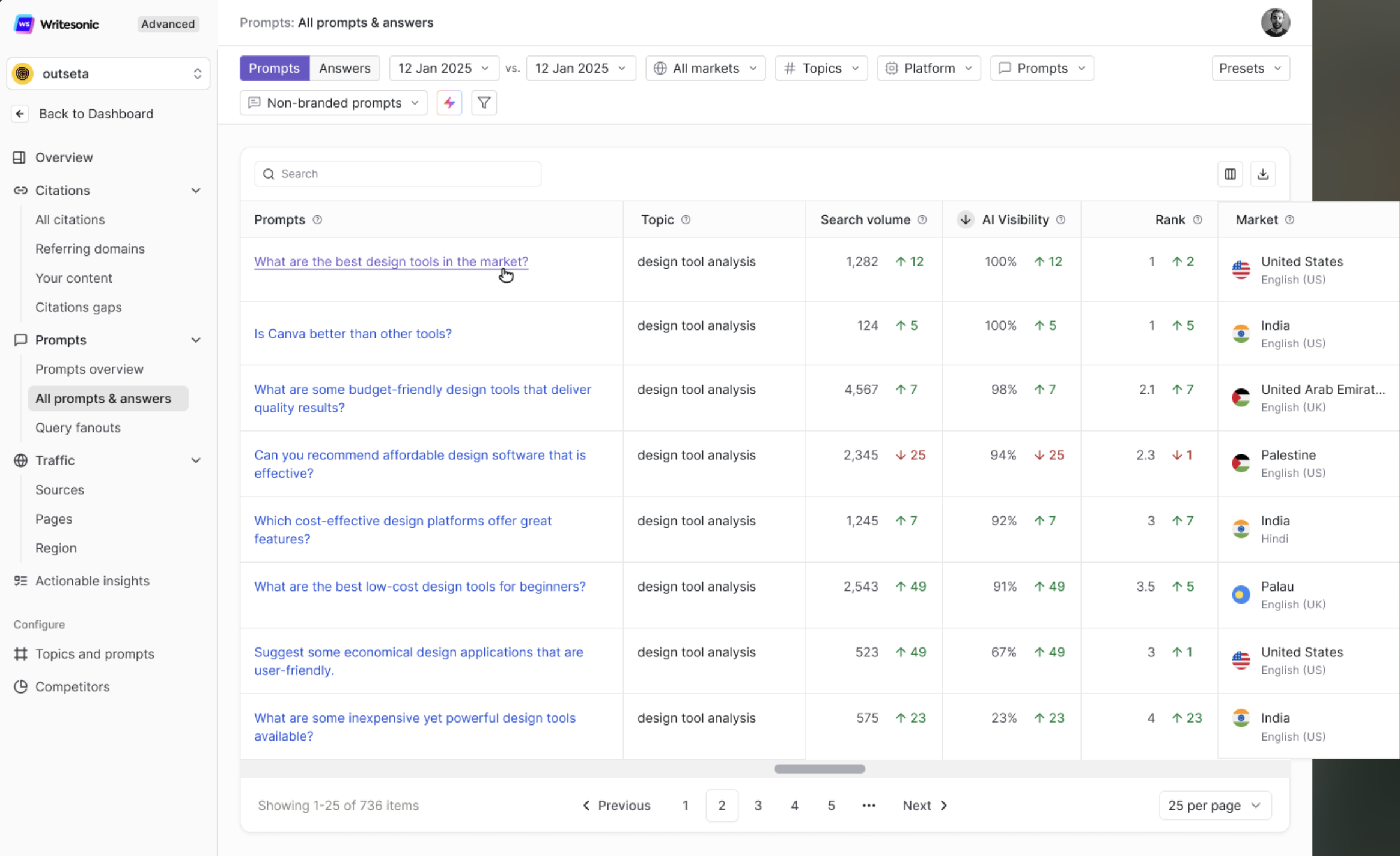
Page-Level Controls
Before diving into either tab, familiarize yourself with the controls at the top of the page. These apply globally and shape the data you see in both tabs.

- Date Selector — Choose the date for which you want to view prompt and answer data. This lets you analyze a specific point-in-time snapshot.
- Comparison (vs.) — Select a second date to compare against. When enabled, change indicators (↑ / ↓) appear next to metrics like Search Volume, AI Visibility, and Rank, showing how values have shifted between the two dates.
- All Markets — Filter data by a specific target market (country + language) or view across all configured markets.
- Topics — Narrow the view to prompts belonging to a specific topic cluster.
- Platform — Filter by a specific AI platform (e.g., ChatGPT, Perplexity, Claude, Google AI Overview) or view data across all platforms.
- Prompts — Quick text search to find a specific prompt by keyword.
- Presets — Save and apply commonly used filter combinations for faster access.
- Non-branded / Branded Prompts Toggle — Switch between viewing prompts that don't contain your brand name (non-branded) and those that do (branded). This helps you separately analyze discovery-intent queries vs. brand-specific queries.
- AI Suggested Filter — Click the lightning bolt icon to surface AI-powered filter suggestions based on your data patterns.
- Advanced Filters — Build multi-condition queries using AND/OR logic across dimensions like Visibility, Rank, Brands Mentioned, and more. This is especially useful for complex analyses like "show prompts where CompetitorX is mentioned but my brand is not" or "prompts with AI Visibility below 50% and Search Volume above 1,000."
Prompts Tab
The Prompts tab gives you a comprehensive, sortable list of every prompt configured in your GEO project. Each row represents a single tracked prompt and shows key performance metrics at a glance.
Table Columns
- Prompts — The exact natural-language query being tracked across AI platforms. Clicking a prompt opens its detailed view.
- Topic — The topic cluster this prompt belongs to (e.g., "design tool analysis," "email marketing software"). Topics are set during onboarding and help you group related prompts for campaign-level analysis.
- Search Volume — The estimated monthly search volume for this prompt. When comparison is enabled, you'll see the change (↑ or ↓) relative to the comparison date. Higher search volume = higher potential visibility impact.
- AI Visibility — The percentage of AI-generated answers (across tracked platforms) that mention your brand for this prompt. This is your core GEO performance metric per prompt. When comparison is enabled, the delta shows whether visibility is improving or declining.
- Rank — Your brand's average position in AI-generated answers for this prompt. A rank of 1 means your brand is the first mentioned. When comparison is enabled, rank changes are shown — a downward number (e.g., ↑ 5) means you've moved up (improved).
- Market — The geographic market and language (e.g., "United States – English (US)", "India – Hindi") for this prompt entry. If you track multiple markets, the same prompt may appear multiple times with different market tags.
How to Use the Prompts Tab
- Identify high-value gaps — Sort by Search Volume (descending) and filter for low AI Visibility. These are high-traffic prompts where your brand isn't showing up — your biggest opportunities.
- Track competitive positioning — Use Advanced Filters to find prompts where a specific competitor is mentioned but you're not.
- Monitor rank movement — Enable date comparison and sort by Rank change to see where you're gaining or losing ground.
- Segment by topic — Use the Topic filter to assess performance within a specific product category or content cluster.
- Market-level analysis — Filter by a specific market to understand regional differences in AI visibility.
Pagination & Export
The table supports pagination (configurable to 25, 50, or 100 items per page) and can be exported for offline analysis or reporting.
Answers Tab
Switch to the Answers tab to see the actual AI-generated responses for each prompt. While the Prompts tab tells you what you're tracking and how you rank, the Answers tab shows you what the AI actually said — and who it mentioned.
Table Columns
- Answers — A preview of the AI-generated response text. This is the actual content the AI platform returned when the prompt was asked. Click to expand and read the full answer.
- Prompts — The prompt that generated this answer. This links back to the corresponding prompt entry.
- Mentions You — Indicates whether your brand was explicitly mentioned in this AI-generated answer. A green check mark (✓) means you were mentioned; a red cross (✗) means you were not.
- Platform — The AI platform that generated this answer (e.g., ChatGPT, Perplexity, Claude, Google AI Overview).
- Rank — Your brand's position within this specific answer. If your brand is not mentioned, this field is blank or shows no rank. When comparison is enabled, the change indicator shows movement.
- AI Visibility — The visibility score for your brand in this specific answer, shown as a percentage with change indicators when comparison is active.
- Brands Mentioned — Displays icons/logos of all brands mentioned in this AI-generated answer, including your brand and competitors. This gives you an instant visual of who the AI is recommending alongside (or instead of) you.
- Topic — The topic cluster associated with this answer's prompt.
- Query Fanouts — Shows the related query categories or fanout types that this prompt/answer maps to (e.g., "Social media content creation," "Online Graphic design"). Query fanouts reveal how AI platforms interpret and expand the original prompt.
- Market — The geographic market and language for this answer.
- Answered On — The date when this AI-generated answer was captured by GEO.
How to Use the Answers Tab
- Gap hunting — Filter Mentions You = No to instantly see all answers where your brand is absent. These are your most actionable optimization targets.
- Competitive intel — Check the Brands Mentioned column to see which competitors appear most frequently and in which contexts.
- Content audit — Read the actual AI answers to understand how AI platforms describe your category and what language they use. Mirror this language in your content.
- Platform-specific analysis — Filter by a specific Platform to see how each AI engine responds differently to the same prompts.
- Track answer freshness — Use the Answered On date to understand how recently AI platforms refreshed their responses for your prompts.
- Understand query expansion — Use Query Fanouts to discover how AI platforms are interpreting and expanding your tracked prompts into related sub-queries.
Switching Between Prompts and Answers
The Prompts and Answers tabs sit at the top of the page and can be toggled instantly. Your active filters carry over between tabs, so if you've filtered to a specific topic or platform, that filter persists when you switch.
Recommended workflow:
- Start on the Prompts tab to identify prompts with low visibility or declining rank.
- Switch to the Answers tab to read the actual AI responses for those prompts.
- Analyze which competitors are mentioned, what sources are cited, and what language the AI uses.
- Use these insights to inform your content strategy, outreach priorities, or Action Center workflows.
Key Metrics Explained
| Metric | What It Tells You | What to Aim For |
|---|---|---|
| Search Volume | How many people search this prompt monthly | Prioritize high-volume prompts for maximum impact |
| AI Visibility | % of AI answers mentioning your brand for this prompt | Higher is better — aim for consistent improvement |
| Rank | Your brand's position in the AI answer | Closer to 1 is better — means you're mentioned first |
| Mentions You | Whether the AI answer includes your brand | Green check (✓) on every high-value prompt |
| Brands Mentioned | All brands the AI recommends in its answer | Monitor competitor presence and identify displacement opportunities |
Tips & Best Practices
- Use date comparison regularly. Comparing data across two dates is the fastest way to measure whether your GEO efforts are working. Look for upward trends in AI Visibility and improving (lower) Rank numbers.
- Prioritize high-volume, low-visibility prompts. These represent the biggest opportunities — lots of people are asking, but AI isn't mentioning you yet.
- Read the actual AI answers. Numbers tell you where you stand, but reading the answers tells you why. Understanding how AI frames its recommendations helps you craft content that earns mentions.
- Combine with the Action Center. Once you've identified gaps on this page, head to the Action Center to find specific, prioritized steps to close those gaps.
- Leverage Advanced Filters for reporting. For enterprise teams, Advanced Filters let you build precise, repeatable queries — ideal for stakeholder reports and weekly audits.
- Track query fanouts. AI platforms often expand a single prompt into multiple related queries. Monitoring fanouts helps you understand the full scope of how your brand is (or isn't) surfacing.
Updated 8 months ago